
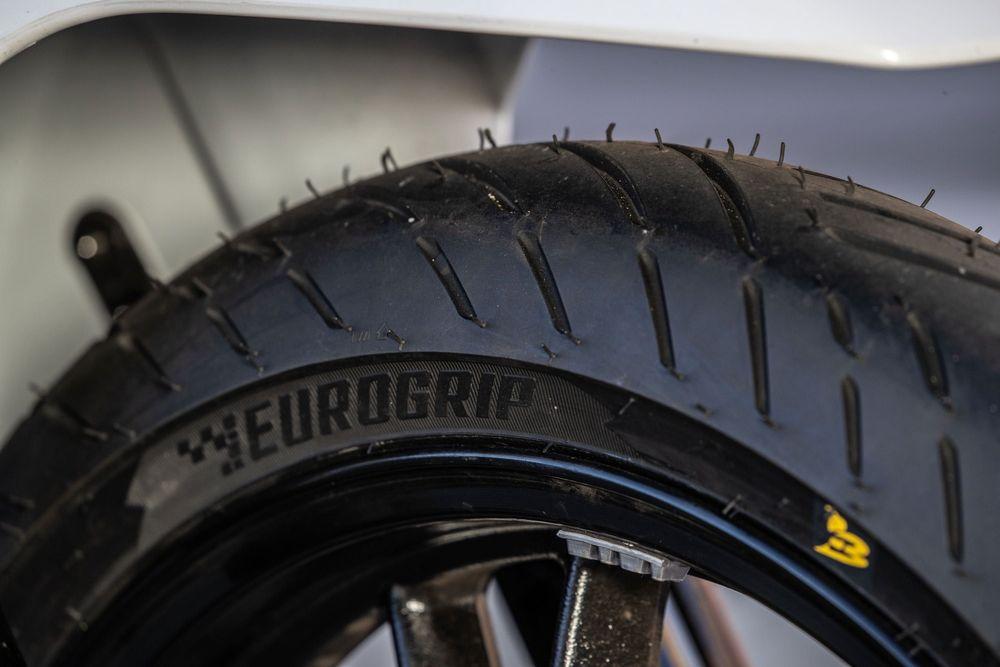
Summary: Your TVS Jupiter deserves tyres that match its reputation as one of India's most reliable scooters. This guide covers everything you need to know about TVS Jupiter tyre size, current price bands across variants, and the best replacement options for daily commuting and light touring. You will find fitment details, ride comfort notes, and specific recommendations, including Eurogrip's Remora and Conta series.
If your TVS Jupiter tyres are worn out, puncturing often, or feeling less stable on rough roads, replacing them with the right size is essential for safety and ride quality. Most TVS Jupiter variants come equipped with 90/90-12 tubeless tyres at both the front and rear, making tyre selection relatively straightforward.
In this guide, we'll explore the stock tyre specifications, latest tyre prices, and the best tyre options available in 2026 to help you get the perfect balance of safety, durability, and value for money.
The TVS Jupiter tyre specification remains consistent across every variant in the lineup. Whether you own a Classic, SMW, STD, ZX, or ZX Disc model, your scooter runs on 90/90-12 tubeless tyres for both front and rear wheels. The 12-inch wheel diameter (304.8 mm) provides that signature planted feel Jupiter owners appreciate.
This uniformity simplifies your replacement decision significantly. You do not need to worry about variant-specific sizing or compatibility issues.
The 90/90-12 profile represents what TVS engineers call the "sweet spot" for this platform. It delivers enough surface area for a confident grip without adding unnecessary weight that would hurt your mileage.
The stock size works in harmony with Jupiter's suspension geometry and Synchronised Braking Technology (SBT). Deviating from this specification can affect braking distance, traction on wet roads, and overall stability during high-speed cornering.
Here is the complete tyre pressure specification:
| Position | Recommended Pressure | Purpose |
|---|---|---|
| Front | 24 PSI | Steering response and comfort |
| Rear | 28 to 34 PSI | Load carrying and stability |
Maintaining correct pressure ensures even tyre wear, optimal fuel efficiency (Jupiter delivers up to 62 kmpl), and safe stopping distances. Check your pressures fortnightly, especially before long rides.
The Jupiter tyre price spans from approximately ₹811 for budget tube-type options to ₹2,500 for premium tubeless tyres. Most riders find their ideal match in the ₹1,100 to ₹1,600 bracket, which covers reliable brands with decent warranties.
Here is what you can expect to pay for quality scooter tyre options that fit your Jupiter:
| Brand & Model | Price (₹) | Warranty | Type |
|---|---|---|---|
| JK Blaze BA23 | 1,080 | 6 Years | Tubeless |
| Apollo Actigrip S5 | 1,124 | Standard | Tube |
| Eurogrip Jumbo GT | 1,199 | 3 Years | Tubeless |
| CEAT Milaze | 1,277 | 6 Years | Tubeless |
| Michelin City Pro | 1,560 | 5 Years | Tubeless |
| MRF Nylogrip Zapper FS | 2,500 | Standard | Tubeless |
Nine manufacturers currently produce Jupiter-compatible tyres, giving you 105 options to choose from. The price differences reflect compound quality, tread technology, and brand positioning rather than fitment variations.
Budget tyres work fine for light city use. Premium options justify their cost through longer lifespan, better wet grip, and superior ride comfort. If you cover more than 50 km daily, investing in the ₹1,200 to ₹1,600 range makes financial sense over 3 to 4 years.
For front fitment, the CEAT Zoom X3 delivers wobble-free handling and excellent manoeuvrability in city traffic. Its optimised rubber compound responds well to quick direction changes during your daily commute.
For rear fitment, consider the CEAT Milaze. It features 10% extra non-skid depth (additional rubber) that resists punctures, and its block design extends tyre life significantly. This combination handles load carrying confidently, even with a pillion passenger.
Eurogrip's Remora and Conta series deserve serious consideration for Jupiter owners. Both use OpT-PaD (Optimised Tread Pattern Design) technology, where the tread pattern is engineered using computer-aided FEA techniques for even footprint pressure distribution. The practical result is tyres that wear evenly and maintain excellent grip in both dry and wet conditions throughout their lifespan.
The Remora suits riders prioritising comfort for daily commutes. Its sidewall construction absorbs road imperfections effectively. The Conta works better for those mixing city riding with occasional highway runs, offering slightly firmer feedback at speed. Both fit the 90/90-12 specification perfectly and carry competitive pricing within the mid-range bracket.
Replace your TVS Jupiter tyre when tread depth reaches the wear indicators positioned between the tread lines. These small raised bars become visible when the tyre has worn to minimum safe levels. You should also replace tyres showing visible cracks, sidewall damage, or uneven wear patterns.
Age matters as much as mileage. Tyres over 5 years old should be replaced regardless of tread condition, as rubber compounds degrade over time. Tyres beyond 10 years become genuinely unsafe and prone to sudden failure.
Signs you need new tyres immediately:
For Jupiter owners covering typical daily distances of 20 to 40 km, quality tyres should last 15,000 to 20,000 km. Track your mileage and inspect tyres monthly to catch issues early.
Eurogrip tyres are designed specifically for Indian road conditions and undergo testing across diverse surfaces.
Their range of scooter tyres includes multiple options for Jupiter fitment, with the Remora and Conta series offering proven durability for riders who want reliable performance without premium pricing.
All TVS Jupiter variants use 90/90-12 tubeless tyres for both front and rear wheels. This applies to Classic, SMW, STD, ZX, and ZX Disc models without exception.
A complete tyre replacement costs between ₹2,200 and ₹5,000 depending on your brand choice. Mid-range options from Eurogrip, CEAT, or Apollo typically total ₹2,400 to ₹3,000 for the pair, excluding fitting charges.
Fitting tyres wider than the stock 90/90-12 size is not recommended. Wider tyres increase rolling resistance (hurting mileage), affect handling in city traffic, and may interfere with suspension and braking system calibration.
JK and CEAT both offer 6-year manufacturer warranties on their Jupiter-compatible tubeless tyres, the longest currently available in this segment.
Check tyre pressure every two weeks for best results. The front should maintain 24 PSI while the rear needs 28 to 34 PSI depending on load. Correct pressure ensures optimal grip, even wear, and maximum fuel efficiency.