
Summary: Buying a new bike tyre isn't as simple as matching the size. This Bike Tyre Buying Guide 2026 walks you through the 10 most important factors every Indian rider should check before making a purchase. From tyre size and tread pattern to rubber compound, manufacturing date, and tubeless compatibility, this guide helps you choose a tyre that delivers the right balance of safety, performance, and value.
A bike's tyres are its only point of contact with the road, making them one of the most critical components for safety and performance. Yet, many riders replace their tyres based solely on price or brand without considering factors that directly impact grip, braking, handling, and longevity.
Whether you're commuting through city traffic, touring on highways, or tackling rough roads, selecting the right tyre can transform your riding experience.
In this guide, we'll cover the 10 essential things every Indian rider should check before buying a bike tyre in 2026, helping you make a well-informed purchase that suits both your motorcycle and riding style.
Knowing how to choose bike tyres starts with understanding what the numbers and codes mean. Here are the first five checks on your bike tyre checklist that determine whether a tyre fits your bike and riding style.
A marking like 120/80-17 M/C 61P tells you everything: 120 is width in millimetres, 80 is aspect ratio (sidewall height as 80% of width), and 17 is rim diameter in inches. The 61 indicates load index (275 kg maximum), while P denotes speed rating (150 km/h).
Always match the exact size specified in your owner's manual or swingarm sticker. Upsizing beyond one step affects speedometer accuracy, ground clearance, and handling geometry. It can also void insurance claims.
Load index numbers range from 35 (121 kg) to 80+ (450+ kg). A 150 cc commuter typically needs a load index between 50 and 62. Cruisers and tourers require higher ratings. Underrated tyres wear faster and risk blowouts when carrying a pillion or luggage. Check your manual for the minimum load index your bike demands.
Speed ratings use letters: J (100 km/h), P (150 km/h), S (180 km/h), H (210 km/h), V (240 km/h). Match or exceed your bike's top speed. A commuter rarely needs anything above P rating, but sport bikes require H or V. Installing a lower-rated tyre compromises safety at highway speeds.
Road/street patterns with closely-spaced tread blocks suit 90% of Indian commuters. They provide maximum grip on dry and wet tarmac, lowest rolling resistance, and quietest operation. Dual-sport patterns work for adventure bikes splitting time between highways and trails. Knobby tyres are noisier and less grippy on smooth pavement, so avoid them unless you genuinely ride off-road.
Tubeless tyres lose air slowly after puncture, letting you ride to a repair shop. Tube-type deflates instantly, which proves dangerous at speed. Tubeless repairs take 5 to 10 minutes versus 20 to 40 minutes for tube patches.
| Feature | Tube-Type | Tubeless |
|---|---|---|
| Air loss after puncture | Instant | Gradual |
| Repair time | 20 to 40 minutes | 5 to 10 minutes |
| Repair cost | ₹50 to 100 | ₹80 to 150 |
| Weight penalty | +300 to 500g | None |
| Rim requirement | Spoke or alloy | Alloy only |
However, tubeless requires alloy rims for an airtight seal. If your bike has spoke wheels, tube-type remains your only option.
The remaining five tyre buying tips India riders need focus on age, warranty, dealer authenticity, and construction type. These checks separate a smart purchase from an expensive mistake.
Every tyre has a four-digit DOT code indicating week and year of manufacture. A code reading 2524 means week 25 of 2024. Tyres older than five years degrade regardless of tread depth. Rubber compounds harden, reducing grip and increasing cracking risk. Reject any tyre manufactured more than two years before your purchase date for optimal performance.
TWI (Tread Wear Indicator) bars sit inside main grooves. When tread surface levels with these bars, immediate replacement becomes necessary. Indian law requires minimum 1 mm depth, but international safety standards recommend 1.6 mm. A simple check: insert a ₹1 coin into the groove. If the entire coin face shows, your tread is dangerously low.
Radial tyres feature layers running perpendicular to travel direction, offering better high-speed stability and cooler running temperatures. Bias-ply tyres use criss-cross layered construction, providing durability and strong load-carrying capacity at lower costs. Sport bikes benefit from radials; commuters and cruisers perform well on bias-ply. Never mix construction types on front and rear.
Most tyre warranties only remain valid when purchased and installed through authorised dealers. Buying from unverified vendors risks counterfeit products and forfeited warranty coverage. Authorised outlets provide correct fitment tools, trained staff, and escalation paths for quality issues. Use brand websites to locate authorised dealers in your area.
Budget tyres (₹700 to 1,400 for commuters) suit light urban use. Mid-range options (₹1,400 to 2,200) balance durability and grip for mixed riding. Premium tyres (₹2,200 to 3,500+) deliver superior wet weather performance and longer life.
| Segment | Budget (₹) | Mid-Range (₹) | Premium (₹) |
|---|---|---|---|
| Scooter | 600 to 900 | 900 to 1,400 | 1,400 to 2,200 |
| 100 cc | 700 to 1,000 | 1,000 to 1,500 | 1,500 to 2,000 |
| 125 to 150 cc | 900 to 1,400 | 1,400 to 2,200 | 2,200 to 3,500 |
| 200 to 250 cc | 1,200 to 1,800 | 1,800 to 3,000 | 3,000 to 5,500 |
For typical commuters covering 8,000 to 12,000 km yearly, rear tyres last 15,000 to 25,000 km while fronts reach 20,000 to 35,000 km.
Following this tyre buying guide of India protects you from unsafe tyres and wasted money. Verify size, load index, and speed rating against your manual. Choose tread patterns matching your actual riding conditions.
Check manufacture date and TWI markers. Buy only from authorised dealers with valid warranty documentation.
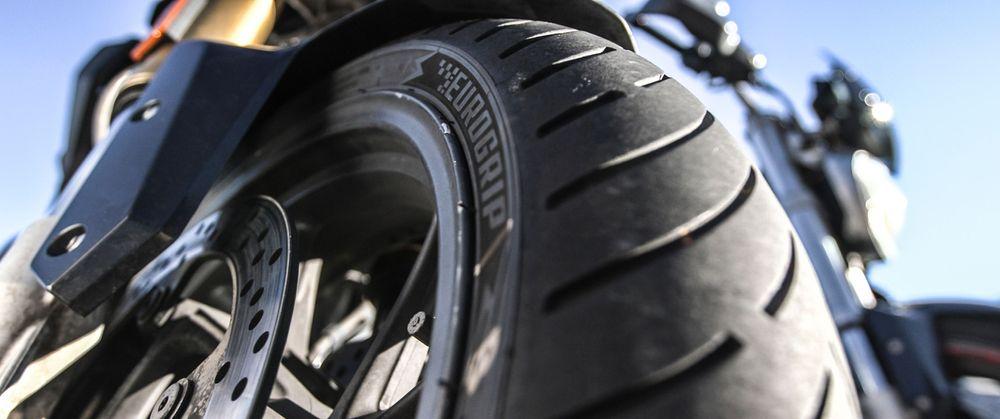
Eurogrip tyres feature A-SeT (Air Seal Inner Liner Technology), a special rubber compound layer that retains air pressure longer than conventional tyres.
This means fewer pressure checks, consistent handling, and superior ride comfort across Indian road conditions. Whether you ride a commuter, sport bike, or scooter, Eurogrip offers options engineered specifically for Indian roads and weather patterns.
Explore the complete Eurogrip tyre range to find the perfect match for your bike and riding style.
Check pressure every two weeks or before any long ride. Incorrect pressure affects grip, braking distance, fuel efficiency, and tyre life. Add 2 to 3 psi when riding with a pillion or heavy luggage.
No. Mixing construction types creates unpredictable handling because each type responds differently to load and temperature. Always use matching construction on front and rear tyres.
Speed ratings indicate maximum safe operating speed: J (100 km/h), P (150 km/h), S (180 km/h), H (210 km/h). Always match or exceed your bike's top speed capability.
Check for inconsistent sidewall printing, missing DOT codes, unusually low prices, and absence of proper warranty documentation. Buy only from authorised dealers listed on brand websites.
Replace any tyre older than five years, even with good tread. Also replace immediately if you notice sidewall cracks, bulges, exposed cords, or experience unusual vibrations and pulling.