
Summary: Your Honda Shine deserves tyres that match its legendary reliability. This guide covers the exact tyre specifications your Shine needs, the correct pressure settings for solo and pillion riding, and a breakdown of the best replacement options across price points. You will also find a maintenance checklist to maximise tyre life and safety.
Honda Shine tyre prices vary depending on the brand, tyre type and retailer. Your Shine uses an 80/100-18 size for both wheels, one of the few Indian motorcycles with identical front and rear dimensions. This simplifies purchasing decisions considerably. Whether you clock 50 km daily or use your Shine for weekend rides, understanding these specifications helps you choose wisely and ride safely.
Your Honda Shine tyre uses the 80/100-18 size on both wheels. Breaking this down: 80 represents the tread width in millimetres, 100 is the aspect ratio (tyre height as a percentage of width), and 18 indicates the rim diameter in inches. The front tyre carries a 47P rating, meaning it handles 175 kg loads at speeds up to 150 km/h. The rear specification reads 80/100-18 54P, offering higher load capacity for rider and pillion weight.
Maintaining correct pressure directly affects your safety, fuel economy, and tyre lifespan. For solo riding, set your front tyre to 25 PSI and rear to 33 PSI. When carrying a pillion, increase rear pressure to 41 PSI to handle the additional load. Check these figures against your owner's manual, as slight variations exist across Shine variants.
Here is your quick reference table:
| Riding Condition | Front Pressure | Rear Pressure |
|---|---|---|
| Solo riding | 25 PSI | 33 PSI |
| With pillion | 25 PSI | 41 PSI |
| Highway touring | 25 PSI | 35 PSI |
Under-inflation causes excessive sidewall flex, generating heat that degrades rubber compounds faster. Over-inflation reduces contact patch area, compromising grip during braking and cornering. A tyre pressure gauge makes it easier to maintain the correct tyre pressure regularly.
Current Honda Shine models feature 18-inch alloy wheels, making tubeless tyres the optimal choice. Tubeless designs offer puncture resistance advantages; a nail or thorn causes gradual pressure loss rather than sudden deflation. If you own an older Shine variant with spoke wheels, stick with tube-type tyres, as tubeless variants cannot seal properly against spoke holes.
Several replacement tyre options are available for the Honda Shine. The best tyre for Honda Shine depends on your priorities: maximum mileage, wet weather grip, or balanced all-round performance. Here is how the top options compare:
| Tyre Model | ApproximatPrice | Type | Best For | Rating |
|---|---|---|---|---|
| Eurogrip Protorq | ₹1,650 | Tubeless | Mileage + grip | 4.5/5 |
| MRF Masseter-X | ₹1,415 | Tubeless | Fuel efficiency | 4.4/5 |
| CEAT Milaze X5 | ₹1,682 | Tubeless | Durability | 4.2/5 |
| Apollo ActiGrip R1 | ₹1,750 | Tubeless | Wet grip | 4.3/5 |
| JK Blaze BR11 | ₹1,699 | Tubeless | All-round | 4.1/5 |
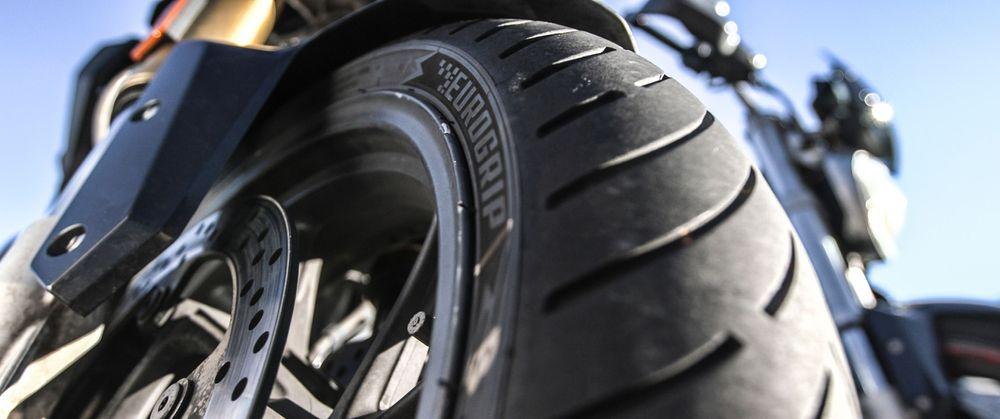
For commuters who value mileage, Eurogrip’s commuter range tyres are a solid choice. With Deep Design Tread (D²T) technology using computer-optimised patterns and a high tread rubber volume, they can offer a long service life under normal conditions when well-maintained. The Tri-Polymer Tread Compound (TriP) strikes a balance between grip and durability without compromising either. Riders have noted consistent performance through both monsoon and summer seasons.
Your bike tyre choice should match your riding style. Aggressive riders who brake hard and accelerate quickly will wear out any tyre faster. Smooth, steady riders can get much more life from quality rubber. Road conditions play a big role too; pothole-filled routes wear tyres down quickly, no matter the brand or compound.
Replacement indicators to watch:
Proper maintenance extends tyre life by 30% or more while keeping you safer on every ride. Follow this monthly routine:
Avoid mixing different tyre brands between front and rear wheels. Mismatched compounds and tread patterns create inconsistent handling, particularly during emergency braking or wet-weather cornering. When replacing one tyre, consider replacing both if the remaining tyre shows significant wear.
For your next Honda Shine tyre replacement, Eurogrip's commuter-focused range offers compelling value. Eurogrip's Optimised Tread Pattern Design Technology (OpT-PaD) ensures even footprint pressure distribution, translating to predictable grip in both dry and wet conditions. With manufacturing facilities in Madurai and Uttarakhand, warranty support and dealer availability remain strong across India.
Can I upgrade my Honda Shine to wider tyres?
You can increase tyre size by up to the motorcycle manufacturer’s recommended limit of the original total diameter. However, wider tyres add rolling resistance and make the bike harder to turn. The stock 80/100-18 size offers the best balance of handling, fuel efficiency, and load capacity for the Shine’s 124cc engine and 123 kg kerb weight.
How often should I check the Honda Shine tyre pressure?
Check tyre pressure weekly or before any ride over 50 km. Tyres naturally lose pressure over time through permeation, so inspect them regularly. Always measure when tyres are cold, as riding heats the air inside and can give falsely high readings.
Why does my rear tyre wear faster than the front?
The rear tyre takes on acceleration forces, braking loads, and the rider’s weight. It usually wears out faster than the front tyre because it handles more load and power. This is normal, so plan to replace the rear more often than the front.
What causes uneven tyre wear on my Shine?
Incorrect pressure is the primary cause. Under-inflation wears the outer edges; over-inflation wears the centre. Wheel misalignment, bent rims, and aggressive cornering also contribute. Address the root cause before fitting replacement tyres.
Is the Honda Shine tyre price worth paying more for premium brands?
Premium tyres from established manufacturers use superior compounds and construction. They typically deliver 40% to 60% longer life than budget options, making the per-kilometre cost comparable. Safety margins in wet conditions also improve significantly with quality rubber.