
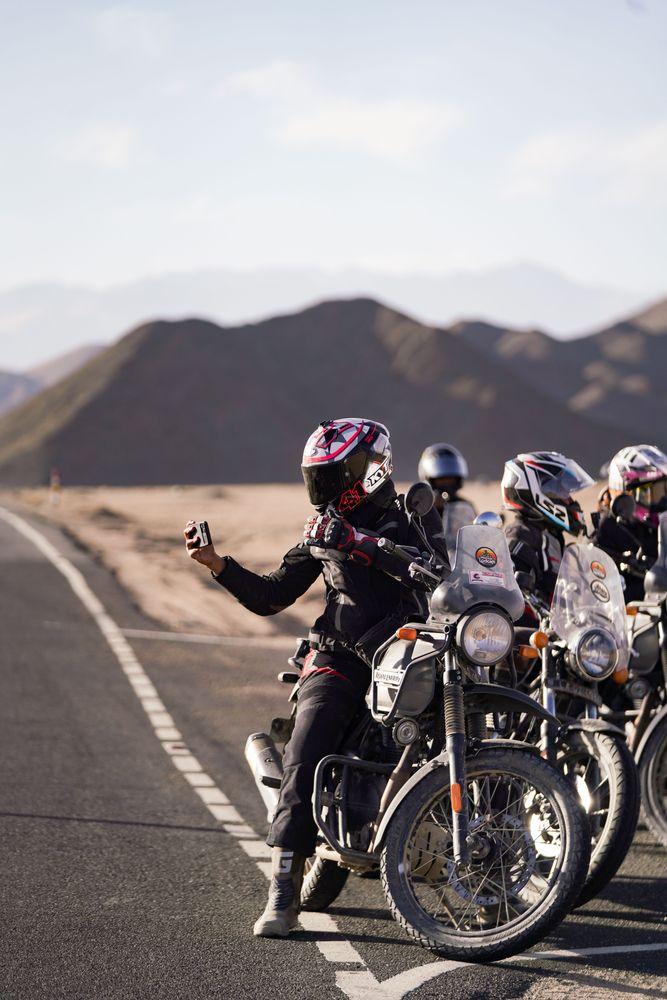
Choosing the right Royal Enfield tyre depends on your exact motorcycle model, riding patterns, and road conditions. This guide covers tyre sizing across the Classic, Bullet, Himalayan, and 650 lineups.
You will learn how to identify replacement signs, understand the grip versus durability trade-off, and match your tyre choice to city commuting, highway touring, or mixed-terrain adventures.
Your Royal Enfield deserves rubber that matches both its character and your riding style. A Royal Enfield tyre that works brilliantly on a Classic 350 may feel wrong on a Hunter or Interceptor 650.
Before scrolling through tyre options online, you need clarity on three things: your exact model's specifications, where you ride most often, and what performance matters most to you. This guide walks you through each decision point, helping you pick confidently without overspending or compromising safety.
Every Royal Enfield model ships with manufacturer-specified tyre dimensions. Fitting the wrong size affects handling, speedometer accuracy, and even your warranty coverage. Here is a quick reference for popular models:
| Model | Front Tyre | Rear Tyre |
|---|---|---|
| Classic 350 (2025 J-series) | 100/90-19 | 120/80-18 |
| Classic 350 (older variants) | 90/90-19 | 110/90-18 |
| Bullet 350 Twinspark | 100/90-19 | 120/80-18 |
| Himalayan 411 | 90/90-21 | 120/90-17 |
| Meteor 350 | 100/90-19 | 140/70-17 |
| Interceptor 650 / Continental GT 650 | 100/90-18 | 130/70-18 |
| Hunter 350 | 110/70-17 | 140/70-17 |
The Royal Enfield Classic 350 tyre size shifted between generations. First-gen models used 90/90-19 front and 110/80-18 rear tyres. The 2025 J-series platform widened both dimensions to 100/90-19 front and 120/80-18 rear. Always check your owner's manual or the sidewall marking on your current tyres before ordering replacements.
Most Royal Enfield models, particularly the Classic and Bullet ranges with spoke wheels, use bias-ply (cross-ply) tyres. These tyres feature fabric layers that cross over each other diagonally. They handle heavy loads well, suit spoke rims, and match the relaxed cruising character of these motorcycles.
Radial tyres run cooler at sustained highway speeds and offer sharper grip during aggressive cornering. However, radial options remain limited in 19-inch and 18-inch sizes. If you own an Interceptor 650 or Shotgun 650 with alloy wheels, radial tyres in sizes like 130/70-18 or 150/70 R17 become viable choices.
Your wheel type dictates this choice. Spoke-wheeled Royal Enfields (Bullet, Classic, Thunderbird variants) require tube-type tyres. Alloy-wheeled models (Hunter, Meteor, Himalayan with alloys, 650 twins) can run tubeless tyres.
Tubeless tyres lose air slowly after a puncture, allowing you to ride to a repair shop rather than stopping immediately. They also generate less heat and weigh slightly less. Tube-type tyres remain the practical choice for spoke wheels, and roadside puncture repairs are straightforward with a basic kit.
The right Royal Enfield tyre balances grip, durability, and handling based on where and how you ride. A daily commuter in Mumbai has different needs than a weekend tourer covering 500 kilometres on NH48.
City commuting priorities:
Highway touring priorities:
Mixed terrain and broken tarmac:
Soft rubber compounds grip tarmac better and shorten braking distances. They also wear faster, sometimes lasting only 15,000 to 20,000 kilometres. Harder compounds extend tyre life but can feel skittish on wet roads or during cold morning starts.
If you ride daily through traffic and monsoon rain, prioritise grip-focused tyres and accept the replacement cost. If you tour loaded for thousands of kilometres across relatively dry highways, lean towards mileage-oriented compounds.
Many riders find a mid-compound tyre delivers acceptable performance in both scenarios. Products featuring advanced tread compounds, like Eurogrip's Tri-Polymer Technology with high-structure carbon, aim to optimise grip, mileage, and durability in a single package.
For the Royal Enfield Classic 350 tyre segment, popular options include the CEAT Zoom Plus (approximately ₹2,000 to ₹2,500), the Eurogrip Beamer YS Plus (approximately ₹2,000 to ₹3,500), and the MRF Zapper (approximately ₹2,000 to ₹3,000).
Each offers a different balance: the Zoom Plus favours mileage-conscious daily riders, the Beamer YS Plus suits those splitting time between city and highway, and the Zapper provides a stock-like, predictable feel.
Recognising replacement signs before a tyre fails is critical for your safety. Check these indicators monthly:
Under normal riding conditions, expect replacement intervals between 25,000 and 40,000 kilometres. Aggressive riding, frequent pillion loads, under-inflation, and poor road surfaces accelerate wear.
Maintenance tips to extend tyre life:
Eurogrip tyres carry a seven-year warranty against manufacturing defects and three years for non-manufacturing issues from the date of manufacture. This coverage applies under standard tread wear conditions, giving you confidence in long-term durability.
Explore compatible Eurogrip tyres for your Royal Enfield to find options matching your model's exact specifications and your riding requirements.
What is the correct tyre pressure for a Royal Enfield Classic 350?
Royal Enfield recommends approximately 28 to 32 PSI for the front tyre and 32 to 36 PSI for the rear when riding solo. Add 3 PSI to the rear when carrying a pillion. Always confirm against your specific model's swingarm sticker.
Can I fit tubeless tyres on my spoke-wheeled Royal Enfield?
Standard spoke wheels are not airtight and require tube-type tyres. Some aftermarket tubeless-compatible spoke wheels exist, but they require professional fitment and verification. Stick with tube-type tyres on factory spoke rims.
How long do Royal Enfield tyres typically last?
Expect 25,000 to 40,000 kilometres under normal riding conditions. Factors like riding style, tyre pressure maintenance, road quality, and load frequency affect actual service life.
Should I replace both tyres together?
Not necessarily. Rear tyres typically wear faster due to drive forces and load. Replace each tyre when it reaches the wear indicator. However, if both are near the limit, replacing together ensures consistent grip front and rear.
What does the tyre speed rating mean?
A rating like 52P indicates the tyre can carry 200 kg at a maximum sustained speed of 150 km/h. Most Royal Enfield models do not approach these limits, but selecting a tyre with an appropriate rating ensures safe performance within your riding envelope.