
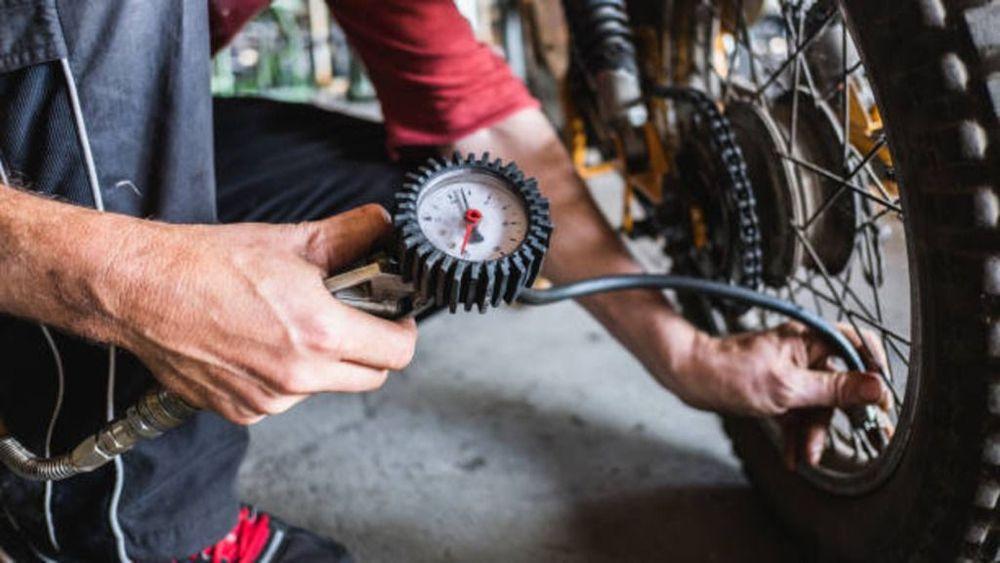
Every rider knows tyre pressure matters, but confusion strikes when you see different units. Your bike manual mentions PSI, the air pump displays Bar, and your tyre sidewall shows kPa tyre pressure readings. These three units measure the same thing, the force of air pushing against your tyre walls, yet many riders struggle with conversions. Getting this right affects everything from fuel efficiency to safety on wet roads.
Understanding pressure units starts with recognising each one's characteristics. These measurements directly impact your riding experience, from grip levels during monsoon rides to tyre longevity on highway runs.
PSI (Pounds per Square Inch) remains the most familiar unit across India. You'll find PSI readings on most bike manuals, swingarm stickers, and standard air pumps at petrol stations. This imperial unit measures how many pounds of force press against each square inch of your tyre's inner surface.
Most Indian motorcycles specify pressures between 28 and 36 PSI. A typical 150cc commuter runs about 28 PSI front and 32 PSI rear, while sportbikes often require 32 PSI front and 35 PSI rear for optimal performance.
Bar represents a metric measurement popular on European tyres and advanced digital gauges. One Bar equals approximately 14.5 PSI, making mental calculations relatively simple. When you see 2 Bar recommended, you're looking at about 29 PSI.
Premium tyres often display Bar alongside other units. Eurogrip's Roadhound series, engineered with 0° steel belt technology, performs excellently within the 1.9-2.5 Bar range typical for performance motorcycles.
What is kPa in tyre pressure? Kilopascals represent another metric unit where 1 Bar equals 100 kPa. This precise measurement appears frequently on tyre sidewalls and advanced TPMS (Tyre Pressure Monitoring System) displays. kPa tyre pressure readings offer greater accuracy, ideal for riders who demand exact specifications.
Converting becomes straightforward once you remember that 1 PSI equals approximately 6.895 kPa. Your typical 30 PSI recommendation translates to about 207 kPa.
Quick conversions save time and prevent costly mistakes. Keep these formulas handy for accurate pressure management across different measurement systems.
Divide PSI by 14.5
Example: 32 PSI ÷ 14.5 = 2.21 Bar
Multiply PSI by 6.895
Example: 32 PSI × 6.895 = 220 kPa
Multiply Bar by 14.5
Example: 2.2 Bar × 14.5 = 31.9 PSI
Divide kPa by 6.895
Example: 220 kPa ÷ 6.895 = 31.9 PSI
| PSI | Bar | kPa |
|---|---|---|
| 28 | 1.93 | 193 |
| 30 | 2.07 | 207 |
| 32 | 2.21 | 221 |
| 35 | 2.41 | 241 |
| 36 | 2.48 | 248 |
These conversions help when switching between gauges or following manufacturer specifications listed in different units. What kPa is in tyre pressure becomes clear; it's simply another way to measure the same critical factor affecting your ride quality.
Accurate pressure readings depend heavily on temperature conditions. Indian weather creates unique challenges requiring specific measurement approaches.
Always check pressures when tyres remain cold, typically after parking for 2-3 hours minimum. Morning checks provide the most accurate baseline readings. Heat from riding increases pressure readings by 4-8 PSI, sometimes reaching 10 PSI increases during summer highway runs.
Never deflate hot tyres based on elevated readings. This common mistake leads to dangerous under-inflation once tyres cool. Instead, note the hot pressure increase and adjust cold pressures accordingly during your next morning check.
Indian summers demand careful monitoring as extreme heat affects kPa tyre pressure readings significantly. Consider these seasonal factors:
Check pressures early morning before temperatures rise
Expect 2-3 PSI natural increase from ambient heat
Avoid maximum sidewall pressures to allow expansion room
Maintain recommended pressures for optimal water evacuation
Proper inflation helps tread sipes channel water effectively
Under-inflation reduces wet grip dangerously
Proper inflation affects every aspect of motorcycle performance. Understanding what kPa in tyre pressure is helps maintain optimal settings for various riding conditions.
Running below the recommended pressures creates multiple problems:
Excessive pressure brings different challenges:
Eurogrip's Protorq Extreme demonstrates excellent performance within recommended ranges, with its multi-compound construction maintaining consistent contact patches. The dual-compound design places harder rubber centrally for mileage while softer shoulders enhance cornering grip.
Successful pressure maintenance requires consistent habits and proper tools. These practices maximise tyre performance regardless of kPa tyre pressure unit preferences.
Choose gauges displaying multiple units
Accuracy within ±1 PSI proves sufficient
Battery-powered models offer convenience
Remove valve caps carefully
Press the gauge firmly for accurate readings
Check twice to verify results
Replace caps to prevent debris entry
Add air in small increments
Recheck after each addition
Allow pressure equalisation between checks
Note the ambient temperature during inflation
Different riding scenarios require pressure modifications:
Eurogrip's Trailhound adventure series handles these adjustments particularly well, maintaining balanced performance across varied conditions when pressures match load requirements.
Master PSI, Bar, and kPa conversions (e.g., 1 Bar = 14.5 PSI) for spot-on tyre inflation, check cold, adjust for load/conditions, and use quality gauges to cut wear, boost fuel economy, and amp safety on Indian roads. Eurogrip shines here: DuCT (Dual Compound Technology) and OpT-PaD (Optimised Tread Pattern Design) maximise grip/mileage, while D²T (Deep Design Tread) ensures even wear at optimal pressures.
Key habits: Convert accurately, monitor weekly, and adapt to rides. Upgrade your game, pair Eurogrip tyres with precise pressure management today!